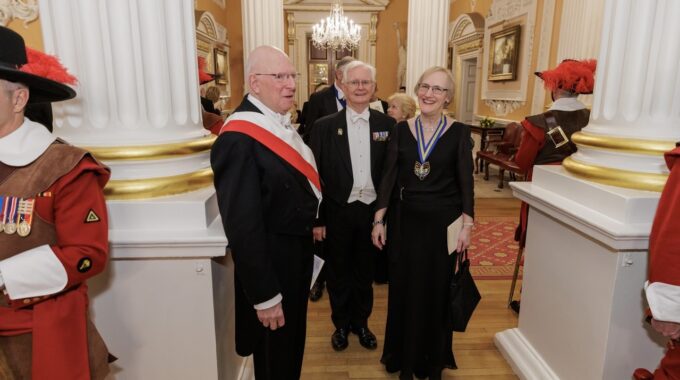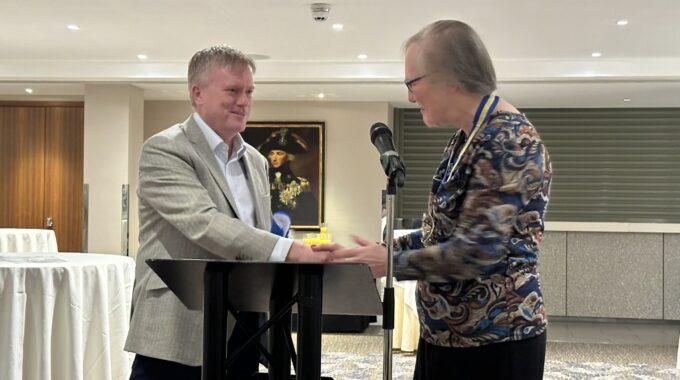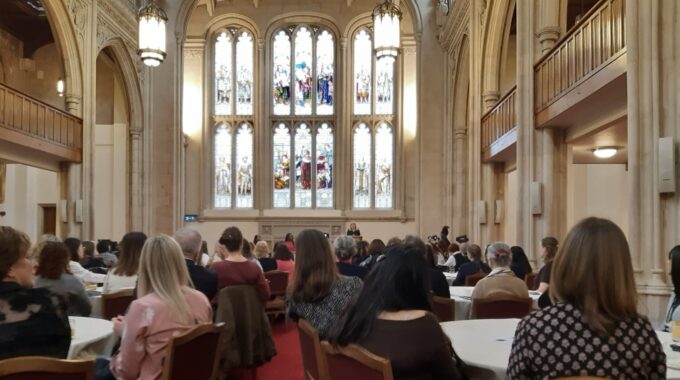
Lady Mayor’s Banquet, Mansion House – Thursday 19 March Each year a Banquet is held…
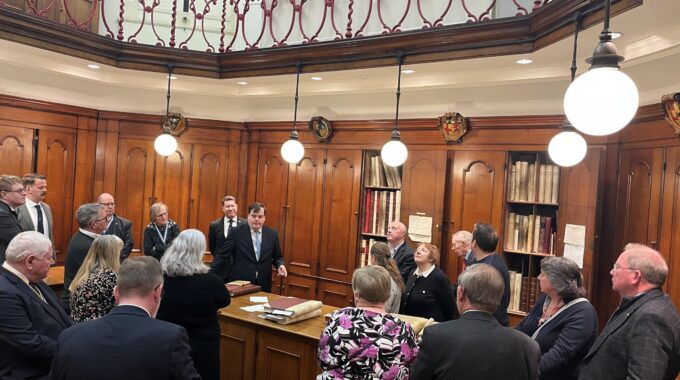
Visit to the College of Arms by Apprentice, Andrew Draper
On Tuesday 20th January, members of the Worshipful Company of Security Professionals were welcomed to the College of Arms for a private visit exploring the history, practice, and enduring significance of heraldry. Our visit was led by the Somerset Herald, Mark Scott MA (Oxford), supported by William Hunt TD BA FCA. Mark is the thirty second holder of the office of Somerset Herald, and previously served as the forty first Portcullis Pursuivant of Arms in Ordinary while William was previously the Windsor Herald from 1999 to 2017; these offices were created by King Henry VII at the time of his coronation in October 1485.
The evening began with a strong smell of varnish, as we had arrived during restoration week, in the High Court of Chivalry. This court handles disputes concerning the rightful ownership and display of armorial bearings, functioning as a tribunal rather than a common law court. It has been convened only twice in the ‘modern’ era, most recently in 1954, and before that in 1737. William opened the visit with an introduction to the development of heraldry in the United Kingdom, explaining that the College of Arms acts as the heraldic authority for England, Wales, Northern Ireland, and several Commonwealth countries, while Scotland falls under the jurisdiction of the Court of the Lord Lyon. We were also introduced to the idea that heraldry is rarely solemn; with ‘cheap puns’ being a recurring feature, and would continue to amuse the group throughout the evening.
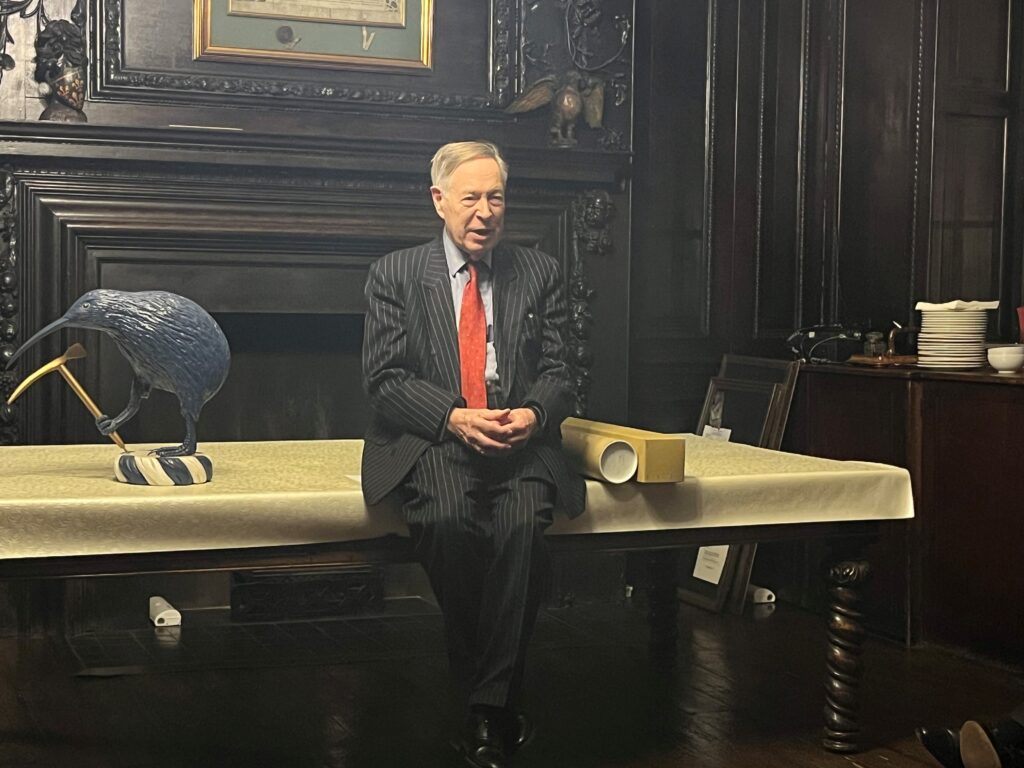
In the first room following the court, we explored both the traditions and the scale of the College’s work. The building has occupied the same site since 1555, the same year in which the College’s constitution, still in use today, was written. William estimated that there are well over one hundred thousand coats of arms and variations in existence, a figure that hints at the breadth of heraldic history preserved within the College. We discussed the arms of Sir Edmund Hillary, whose crest features a kiwi to represent his New Zealand nationality, holding an ice pick in reference to his mountaineering achievements. We also learnt some of the technical language of heraldry, including the counterintuitive fact that ‘dexter’ and ‘sinister’ are reversed from their standard Latin meanings, as they are described from the perspective of the person bearing the shield rather than the viewer. While there are no fixed criteria for eligibility for a grant of arms, ‘eminence’ is considered favourably, though in keeping with a constitution nearly five centuries old, no formal definition of eminence exists – so if you think you’re ‘eminent’ give them a call!
We then passed through an unassuming wooden doorway, which conceals a substantial vault door, and entered the archive. The archive is believed to contain the oldest surviving working iron shutters still in use as part of the fire protection system where they are cranked open and closed each day. Lining the walls are cupboards holding more than seven thousand handwritten and entirely unique manuscripts, recording coats of arms, pedigrees, genealogies, and related material. Within this remarkable space, we examined the arms of several notable individuals and organisations. Among these were the arms of Horatio Nelson, which evolved repeatedly over the course of his career. The example we viewed included a British sailor trampling a Spanish flag as the dexter supporter, with a lion as the sinister supporter, itself tearing a Spanish flag in its mouth. Nelson was evidently not inclined towards subtlety, adding new elements to his arms after each victory, including references to the Nile following the eponymous battle. We also discussed the arms of organisations such as the Metropolitan Police, GCHQ, and MI5, the latter having commissioned a coat of arms before it was officially acknowledged to exist; a secret coat of arms proving to be a particularly neat paradox.
Another highlight of the archive was the opportunity to examine and discuss the Company’s own arms. We learnt that the dancetty, the jagged line where the blue meets the yellow, forms three stylised W’s, symbolising security in the digital realm. This served as a reminder that in heraldry every element has meaning, even those that might initially pass unnoticed.
The visit offered a fascinating insight into a world where history, symbolism, and modern identity intersect with remarkable consistency. Our thanks go to Mark Scott and William Hunt for their expertise, clarity, and enthusiasm, and to Andrew Knights who organised an evening that was both informative and enjoyable.
Andrew Draper, Apprentice
Related Posts